
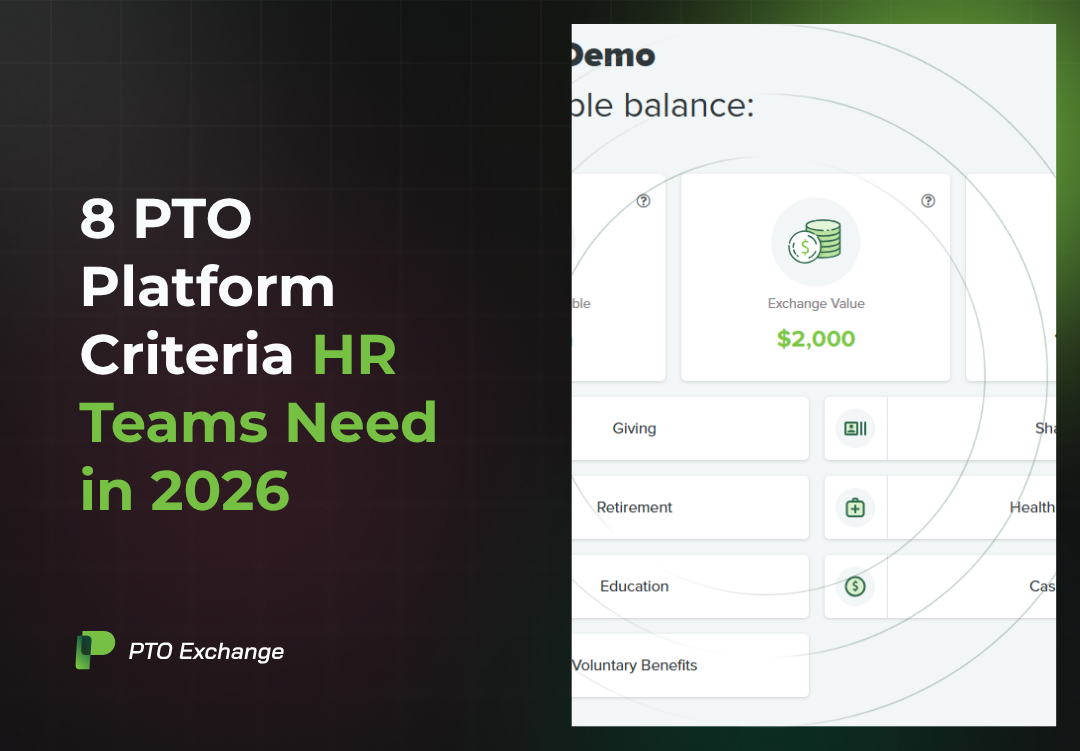
8 PTO Platform Criteria HR Teams Need in 2026
HR teams evaluating a PTO conversion platform should require eight things before signing a contract: IRS compliance validation, a documented no-cost funding model, native payroll integrations, independent security certification, proven retention data, multiple financial wellness destinations, all-50-state legal defensibility, and dedicated implementation and audit support. Skip any one of these and a modern benefit can turn into legal and financial exposure instead of a retention win.
Most PTO platforms on the market were built to solve one narrow problem, usually a cash-out mechanism, without the compliance architecture to support it at scale. The eight criteria below are what separates a platform HR can defend to Legal, Finance, and Audit from one that creates new risk.
.
1. IRS Compliance Validation, Not Just a Legal Opinion
A homegrown or lightly built PTO cash-out program can unintentionally trigger IRS Constructive Receipt issues, since employees may be taxed on PTO value the moment they have the option to convert it, whether or not they do. A platform's compliance claim should rest on IRS private letter rulings, not an internal legal memo.
2. A Documented No-Cost Funding Model
Ask exactly how the platform is funded. A credible answer names a specific mechanism, such as a service charge built into the transaction, rather than a vague claim of being free. HR should be able to explain the funding model to Finance in one sentence.
3. Native Payroll and HRIS Integrations
Middleware "bolt-ons" and manual file transfers introduce data lag and error risk. Look for native integrations or file upload mechanism with the systems already running payroll, such as Workday, ADP, UKG, and Ceridian, rather than a promise to build one after signing.
4. Independent Security Certification
SOC certification should be current, not aspirational. SOC II Type 2 covers security operations over a sustained period, while SOC I Type 2 covers controls relevant to financial reporting. A platform touching payroll data and PTO liability should hold both.
5. Proven Retention and Turnover Data
Marketing claims are easy to write. Ask for documented, customer-specific turnover data, ideally from an employer with a comparable workforce size, rather than an industry-average statistic dressed up as platform performance.
6. Multiple Financial Wellness Destinations
A platform limited to a single cash-out option serves one generation and one financial need. Look for a range of destinations, including retirement contributions, HSA funding, student loan repayment, emergency savings, leave sharing, and charitable giving, so the benefit works across a multi-generational workforce without new debt.
7. All-50-State Legal Defensibility
PTO and wage laws vary significantly by state, and a platform validated in a handful of states will not hold up for a distributed workforce. Confirm defensibility across all 50 states before rolling the benefit out company-wide.
8. Implementation and Ongoing Audit Support
Compliance is not a one-time setup task. Ask what audit-readiness support looks like a year after go-live, not just during onboarding, and who owns that relationship on the vendor side.
Where PTO Exchange Fits
PTO Exchange was built around these eight criteria rather than retrofitted to meet them. The platform holds U.S. Patent US10108933 B1 as the category creator, is IRS-validated through private letter rulings, and carries both SOC II Type 2 and SOC I Type 2 certification.
It integrates natively with quick easy uploads for Workday, ADP, UKG, and Ceridian, is funded entirely through its own service charge at no net recurring cost to the employer, and offers destinations spanning retirement, HSA, student loans, emergency savings, leave sharing, and charitable giving.
Fairway Independent Mortgage, a workforce of more than 2,700 employees, saw 57.2% lower turnover among employees who used the platform compared to those who didn't.
See how the PTO Exchange platform in action in a live sandbox: https://www.ptoexchange.com/demo-landing-page
Frequently Asked Questions
What is a PTO conversion platform?
A PTO conversion platform lets employees redirect the dollar value of earned, unused PTO toward a financial goal, such as retirement savings, an HSA, student loan repayment, or charitable giving, instead of forfeiting it or taking it as a lump-sum payout.
Is PTO conversion the same as a PTO cash-out program?
No. A cash-out program typically pays employees the value of unused PTO directly, which raises IRS Constructive Receipt concerns. A conversion platform routes that value directly to a qualified destination under IRS-validated rules, avoiding that exposure.
Do employees pay a fee to use the platform?
With PTO Exchange, the platform is funded through its own built-in service charge and carries no net cost to the employer or a separate out-of-pocket fee for the employee beyond that charge.
How is this different from Earned Wage Access?
Earned Wage Access advances employees a portion of wages they haven't been paid yet, which is a form of short-term debt. PTO conversion redirects value the employee has already earned, with no repayment and no new debt.






![image 34 [Vectorized]-1](https://www.ptoexchange.com/hubfs/PTO2026/image%2034%20%5BVectorized%5D-1.svg)
![image 35 [Vectorized]](https://www.ptoexchange.com/hubfs/PTO2026/image%2035%20%5BVectorized%5D.svg)
![image 36 [Vectorized]](https://www.ptoexchange.com/hubfs/PTO2026/image%2036%20%5BVectorized%5D.svg)
![image 37 [Vectorized]](https://www.ptoexchange.com/hubfs/PTO2026/image%2037%20%5BVectorized%5D.svg)